

Quick start
New to OPSMAPIA? These four steps take you from an empty map to a working operations picture.
- Build your structureCategories, groups and types that match how your organization works.
- Add your first spotRight-click the map, describe what happened, rate it and save.
- Draw your areasAreas of interest, out-of-bounds zones and geofences that alert you.
- Bring in your teamThey sign in to the mobile app, share their location and can call SOS.
How OPSMAPIA works
OPSMAPIA is a global mapping tool for domestic and international operations. You create your own structure of spots to match how your organization works, plot incidents, locations and assets under it, and share them with everyone in your organization in real time.
Spots come in two kinds, set by their category:
- Time based spots are events, such as incidents and reports. They have a date and follow the date filters, and new ones glow so they stand out.
- Static spots are places, such as offices, safe havens and checkpoints. They are always on the map.
Around your spots you draw overlays for areas of interest and out-of-bounds zones, follow your team from the mobile app, and keep track of everything with charts, records and logs. Each update reaches every user visually and audibly the moment it is saved.
Signing in, levels and channels
Sign in at opsmapia.com/app/ with the username and password your administrator gave you. OPSMAPIA opens on the map, where you left it last time. The same account signs in to the mobile app.
What you can do depends on your level, which your administrator sets:
| Level | What it can do |
|---|---|
| Admin | Add, edit and delete any spot or overlay in their channel, send messages to the team and set up geofences. |
| Member | Add spots and overlays, and edit or delete the ones they created. |
| Viewer | See everything in their channels, without changing anything. |
Channels
Your organization works in its own channel: everything you add goes there, and everyone in it sees it as it happens. Your account can also follow categories from other channels, such as the reports of OPSMAPIA's own analysts if you use Analysis. They sit in the Spot Manager beside your own, marked with a lock: you can show, filter and search them, but not change them.
Keeping your account safe
- Four wrong passwords in a row block signing in to that account from your address for 15 minutes, on the web and the mobile app alike. Until then even the right password is refused, so wait before trying again.
- While the map is open you stay signed in. Otherwise a sign-in lasts a day.
- Sign Out, in your account menu, signs out that browser only. You can be signed in on several devices at once.
- Change your password in Profile. If you've forgotten it, contact us and we'll set a new one.
A look around
The map fills the window, and everything else floats over it.
- The top bar has the pages Map, Records, Charts and Widgets, and on the map the buttons for GEO Search, the Time Based Spots Calendar, Messages and the Spots List View. Your avatar on the right opens your account menu.
- The top left has the Spot Manager, Overlay Manager, Base Maps and Tracking History.
- The bottom left has the map tools: traffic, the heatmap, live tracking, drawing tools, the measuring tool, zoom and My Location.
- The footer shows the MGRS grid reference and latitude and longitude under your pointer, with the time in UTC and locally.
Right-click anywhere on the map (or press and hold on a touch screen) for Add New Spot, Zoom In to This Area, Show on External Map to open the place in Google Maps, and Area Information for its country, local time and time zone.
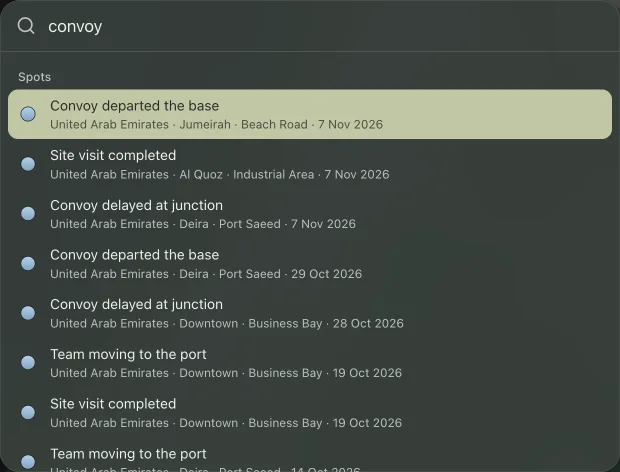
To jump anywhere quickly, press ⌘K on a Mac or Ctrl K on Windows to open Find Anything and type the name of a page, panel or spot. Clicking the OPSMAPIA logo reloads the map.
Build your structure
Before you add spots, set up the structure they live in. OPSMAPIA is hierarchical: each category holds groups, and each group holds types. A spot always belongs to a category and a group, and may have a type.
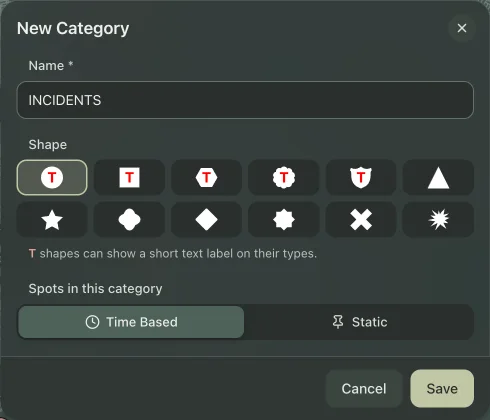
- The category sets the spot's shape and whether its spots are Time Based or Static.
- The group sets the fill colour, the border colour and the border width.
- The type can add a short label of up to two characters on the spot, in a colour you choose, for shapes that have room for one.
Create a category, a group and a type
- Open the Spot Manager at the top left.
- At its foot, after New, choose Category. Give it a name, pick a shape and choose whether its spots are time based or static, then choose Save.
- Choose Group, pick the category it belongs to, name it and choose its colours, then save.
- Choose Type, pick its category and group, name it and add a label if you like, then save.
You can also choose + on any row of the tree to add a group or type under it, or right-click a row to edit or delete it. Deleting a category or group also deletes everything inside it, so OPSMAPIA asks first. Drag rows to reorder them, then choose Save Order.
Show and hide spots
Tick or untick any category, group or type in the tree and the map changes at once, with a count beside each row. Show All and Hide All do the whole tree, and the search box finds a category, group or type by name.
Add your first spot
- Choose Spot at the foot of the Spot Manager and click the map where the spot belongs. You can also right-click the map and choose Add New Spot, or on a phone or tablet use the Add Spot button.
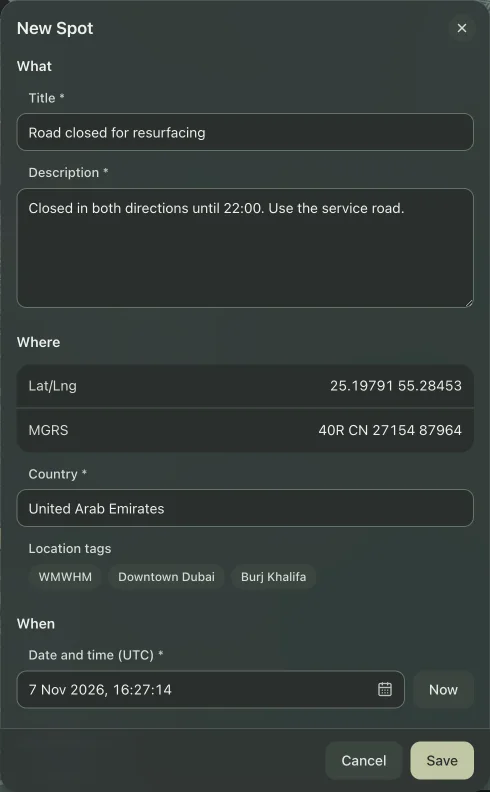
- The New Spot form opens. Give it a title and a description.
- Check its place: the latitude and longitude, MGRS, country and location tags are filled in for you.
- Set the date and time, or choose Now to stamp the current time.
- Pick its category, group and, if you like, its type.
- For reports, rate the impact level, the source reliability and the information credibility. Rating a report explains the scales.
- Add a source link, and drop up to six photos or PDF files on Files.
- Choose Save.
Your spot appears on the map, and everyone else online hears an alert and sees it arrive. A new time-based spot glows for the hours set in each person's profile.
Rating a report
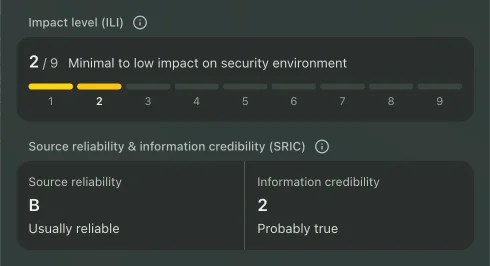
A report can carry three ratings, so anyone reading it can judge at a glance how much it matters and how far to trust it. They follow scales used across security and intelligence work, and in the app the i beside each rating opens its full definition.
Impact level (ILI)
The Impact Level Indicator scores an incident's effect on the security environment. Add up the points for what it caused:
| What the incident caused | Points |
|---|---|
| Casualties | 1 |
| Fatalities | 2 |
| Material damage | 1 |
| Damage to national critical infrastructure, or to government and institutional infrastructure | 2 |
| Temporary consequential acts | 1 |
| Protracted consequential acts | 2 |
The total runs from 1 to 9: 1 is minimal impact, 3 low, 5 moderate, 7 high and 9 extreme, with the even numbers in between.
Source reliability and information credibility (SRIC)
Two separate questions, on the NATO STANAG 2511 scales: how reliable is the source, and how credible is this piece of information?
| Source reliability | Meaning |
|---|---|
| ACompletely reliable | A tried and trusted source that can be depended on with confidence. |
| BUsually reliable | Successful in the past, with some doubt in this particular case. |
| CFairly reliable | Used occasionally before, with some degree of confidence. |
| DNot usually reliable | Used before, and more often unreliable than not. |
| EUnreliable | Used before, and has proved unworthy of confidence. |
| FReliability cannot be judged | Not used before. |
| Information credibility | Meaning |
|---|---|
| 1Confirmed by other sources | Confirmed by a source independent of the one that reported it. |
| 2Probably true | Not independently confirmed, but likely, judged by earlier reports. |
| 3Possibly true | Not confirmed, but it doesn't conflict with what is known. |
| 4Doubtful | It tends to conflict with what is known. |
| 5Improbable | It clearly contradicts what is known. |
| 6Truth cannot be judged | There is nothing to compare it with yet. |
Read together, the letter and the number make the rating: B2 is a usually reliable source with information that is probably true, and F6 means neither can be judged yet. Rate the two apart: a reliable source can still pass on doubtful information.
Working with spots
- Details. Click a spot to open its details: its description, place, ratings, source, files and photos.
- Edit and move. Right-click a spot and choose Edit. While the form is open the spot can be dragged to a new place. Choose Save Changes when you're done.
- Copy. Choose Copy, then right-click where you want the copy and choose Paste Spot.
- Share. Choose Share and copy the link. Whoever opens it sees that spot on a map of its own, with its details, files and base maps, without signing in.
- Delete. Choose Delete and confirm. Its files are deleted from the server too.
Overlays and geofences
Overlays mark areas and lines on the map: areas of interest, out-of-bounds zones, routes, perimeters.
- Open the drawing tools with the pencil at the bottom left, or choose Overlay in the Overlay Manager.
- Choose a circle, rectangle, polygon or line and draw it. Guidance appears at each step, with Done and Cancel.
- In the New Overlay form, choose its group, give it a title and description, and set its fill, border and on-map label.
The Overlay Manager keeps overlays in groups, with a search box, Show All and Hide All. An overlay or a whole group can be disabled for everyone and enabled again later.
Geofences
An admin can turn a saved circle, rectangle or polygon into a geofence. Edit the overlay, switch on Geofence, choose the assigned users, and choose to be alerted when one of them enters the area, leaves the area or goes over a speed limit inside it. Optional limits ignore locations less accurate than a set number of metres, and leave a cooldown between alerts. Alerts arrive in Messages as geofence alerts.
Search and filter
GEO Search
- Place finds a place or address by name.
- Coordinates goes to a latitude and longitude or an MGRS grid reference.
- Draw Area lets you draw a shape and lists every spot inside it, counted by group, with their dates.
- Route takes a start and an end, follows the road, and shows every time-based spot within 1, 2, 5 or 10 km of it, with the distance and driving time.
Dates
The Time Based Spots Calendar sets which dates the map shows: Today, 7 days, 30 days, All, or any range on the calendar. It only affects time-based spots; static spots stay on the map.
The spot list
The Spots List View lists the spots on the map, searchable and in pages of 25, 50, 100 or 200. Filter Spots narrows it by kind, structure and dates, and the map follows: what the map shows is what the list shows. A pill at the top of the map says when a filter is on, with Clear to remove it.
Base maps and map tools
Base Maps offers twelve styled maps, from Military Colors (the default) and Neutral Blue to Desert and Porcelain, plus Satellite and Terrain. The Labels switch turns place and road names on or off. Your choice, like your position on the map, is saved to your account by itself.
- Traffic shows live road traffic.
- Heatmap turns the spots that match your filters into a heatmap.
- Measuring tool measures distances point by point, with the length of each part.
- My Location takes the map to where you are.
Messages, tracking and SOS
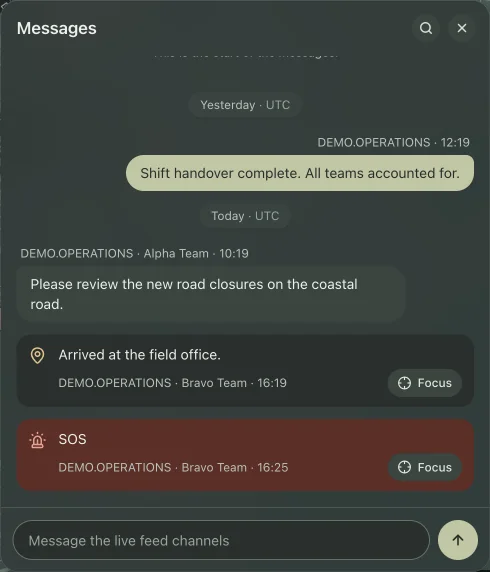
Messages gathers team messages, check-ins and pictures from the mobile app (shown as location reports), SOS calls and geofence alerts. Choose Focus on a location report or an SOS to see where it was sent from, and photos open in place. Search and filter them by person, kind and date. Admins can also send messages to the team, which reach their phones.
People who share their location from the mobile app appear on the map live, with their speed and grid reference. The tracking button at the bottom left shows or hides them, and is on each time you open the map. A person leaves the map when they stop sharing, or five minutes after their last update. Tracking History lists each device's paths from the last 30 days, with their times, points and top speed; choose one to draw it on the map.
When someone calls SOS from the mobile app, everyone online hears an alarm, the top bar turns red and a message shows who needs help. The SOS appears in Messages with its location.
Widgets
Widgets keep what you watch on the map, on glass over it. You can have up to five. Open Widgets in the top bar and choose one to add:
- World Clock: the time in any time zone, digital or analog.
- Legend: a category's groups and types with their shapes, with numbers and only the active ones if you like.
- Chart: a total, trend, columns or breakdown for the last 24 hours, 7 or 30 days, 3 or 12 months.
- Weather: conditions and the coming days at the map's centre or any city, small, medium or large, in °C or °F.
- Team: everyone's status, or follow one person on a small map of their own.
Switch Show on Map on or off for each one. On the map, drag a widget where you want it, and drag a legend's corner to resize it.
Records, charts and exports
- Records is a searchable table of every spot your account can see, by title, description, country, location tag, structure and date.
- Charts shows time-based spots by category over the last 10, 30 or 90 days, the last 12 months or any range, with the busiest day and largest category. Choose Print for a paper copy.
- Export Map, in your account menu, captures your current view as an image.
- Export Spots CSV downloads a spreadsheet of the spots on your map, with their ID, title, description, category, group, type, country, location tags and date.
Your profile
Open Profile from your account menu to change:
- your full name,
- the glow duration: how many hours new time-based spots glow (zero turns it off),
- whether times show in UTC or your local time,
- your password (at least 8 characters, with a number, a lowercase and an uppercase letter).
Choose Save when you're done. Channel Activity in the same menu shows what has changed in your channel.
The mobile app
OPSMAPIA for iPhone and Android connects people in the field to the operations room. They sign in with the same username and password as on the web, and the app remembers them.
Share your location
- On the Location tab, START begins live tracking: the operations room sees you move on the map, with your speed. STOP ends it.
- Allow location access when the phone asks. On Android, choose to allow it all the time, so tracking carries on while the phone is locked.
- Check-in sends your position once, as a location report. Picture takes a photo and sends it with your position.
Call for help
To call SOS, slide the red handle on Slide to SOS all the way across. Your position goes at once to the operations room and your team, with an alarm. There is no confirmation and it can't be taken back, which is why it takes a full slide; letting go early sends nothing. The SOS needs location access to send.
Messages and alerts
- Messages is the conversation with the operations room and your team. Add a photo from the camera, or your position.
- Alerts lists new time-based spots, or shows them on a map, with a search and a date range.
- New alerts and messages arrive as notifications, even when the app is closed. Allow notifications when the phone asks.
Location is only shared with the person's permission, with their organization's designated managers, and is kept for no more than 30 days.
Troubleshooting
I can't sign in
Check your username and password. After four wrong tries, signing in to that account from your address is blocked for 15 minutes, and even the right password is refused until then, so wait before trying again. If you've forgotten your password, contact us.
Spots I expect aren't on the map
Check the dates in the Time Based Spots Calendar, whether a filter pill shows at the top of the map, and that the category, group and type are ticked in the Spot Manager.
I don't hear alerts
Check your computer's sound and that the browser tab isn't muted. Some browsers only play sound once you've clicked on the page. Alerts also wait while you fill in a form or draw, and arrive when you finish.
Someone on my team isn't on the map
They need to press START on the mobile app's Location tab, with location access allowed. Make sure the tracking button at the bottom left of the map is on. A person leaves the map when they stop sharing, or five minutes after their last update.
Which browsers can I use?
OPSMAPIA runs in current versions of Chrome, Edge, Firefox and Safari, on Mac, Windows and Linux.
Still stuck? See the FAQ or contact us.
Glossary
- Spot
- A point on the map: an incident, a report, a place or an asset.
- Time based spot
- A spot that is an event, with a date. It follows the date filters, and glows while it is new.
- Static spot
- A spot that is a place, such as an office or a safe haven. It is always on the map.
- Category, group, type
- The three levels of your structure. The category sets a spot's shape and kind, the group its colours, the type an optional short label.
- Overlay
- An area or line drawn on the map: a circle, rectangle, polygon or line.
- Geofence
- An overlay that raises an alert when an assigned person enters it, leaves it or goes over a speed limit inside it.
- Channel
- Your organization's own space in OPSMAPIA. Everything added in it is shared with everyone in it.
- MGRS
- Military Grid Reference System: a grid reference such as 40R CN 18848 75575, shown beside latitude and longitude.
- ILI
- Impact Level Indicator: a report's impact on the security environment, from 1 (minimal) to 9 (extreme).
- SRIC
- Source reliability (A to F) and information credibility (1 to 6), read together as a rating such as B2.
- Check-in
- A one-off location report sent from the mobile app.
- Live tracking
- A person's position, shared from the mobile app and shown moving on the map.
- SOS
- A call for help from the mobile app, with the sender's position, raised as an alarm for everyone online.
Pictures in this guide show the OPSMAPIA app with sample data.